




How do I choose the right battery?
The right battery for the right purpose!
More and more products are powered by batteries, which play an important role in their functionality. That is why it is important to know the difference between different types of batteries. The battery guide explains the different concepts, answers frequently asked questions and provides an overview of our range of batteries.
When choosing a battery, you need to know the product's requirements in terms of battery type, voltage and capacity.
Different types of batteries
Batteries are normally divided into two categories: primary and secondary batteries.
A primary battery is a disposable battery that cannot be recharged. Once it is empty, it is used up. Examples of common primary batteries are alkaline and button cell batteries.
A secondary battery is a rechargeable battery that can be recharged repeatedly and thus reused. Common secondary batteries are NiMH (nickel metal hydride) and Li-Ion (lithium ion). NiMH is currently the most popular type of rechargeable cylindrical battery. It is an environmentally friendly alternative free from cadmium, which also has a higher capacity than disposable batteries. The NiMH battery has a terminal voltage of 1.2 V and can replace common alkaline batteries with a terminal voltage of 1.5 V in almost all contexts. Li-Ion batteries have a high energy density and a voltage of 3.2 V or 3.7 V. They cannot replace batteries with a different voltage, even if the size is the same.
Please note that if your product requires a secondary battery, it cannot be replaced by a primary battery. For example, a solar cell product requires a rechargeable battery, while an LED light for indoor use can use either type.
The correct voltage is required for the product to function properly
The unit of measurement for voltage is volts (V). Depending on how a battery is constructed, it will emit slightly different voltages.
- An alkaline battery has a voltage of 1.5V.
- A rechargeable NiMH battery has a voltage of 1.2V.
- A rechargeable Li-ion battery normally has a voltage between 3.2V and 3.7V.
The battery voltage is the most important value you need to keep track of to ensure that your product works properly. If you accidentally insert a battery with a higher voltage than the product is designed for, you risk damaging the product or even making it dangerous. If you insert a battery with a lower voltage, there is a risk that the product will not work properly. In most cases, however, it is perfectly fine to replace a 1.5V battery with a 1.2V battery.
Most batteries must be marked with their voltage, which makes it easy to see the battery's ‘rated voltage’. The voltage indicated on a battery refers to a fully charged and unloaded battery.
Capacity
The capacity of a battery refers to the stored energy in the battery and is usually specified in the unit of measurement Ah (ampere hour) or mAh (milliampere hour). Ampere is the unit of measurement for electric current, which means that the capacity is the maximum amount of current that the battery can deliver in one hour.
For example, a rechargeable battery with a capacity of 2000 mAh can theoretically deliver a current of 2000 mA for one hour, 200 mA for 10 hours or 20 mA for 100 hours.
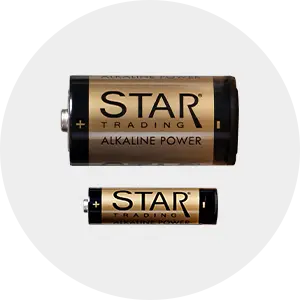
Alkaline batteries
Alkaline batteries are the most commonly used disposable batteries today and are completely free of environmentally hazardous metals. All our alkaline batteries have high capacity, known as Longlife.
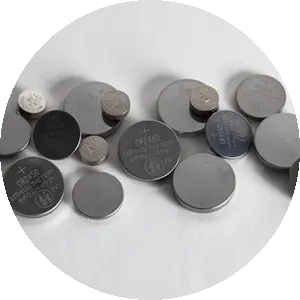
Button cell batteries
A button cell battery is a disposable battery that resembles a button and comes in many different sizes. For lithium batteries, the name indicates the size of the button cell battery, e.g. CR2032 – 20 mm in diameter and 3.2 mm in height.
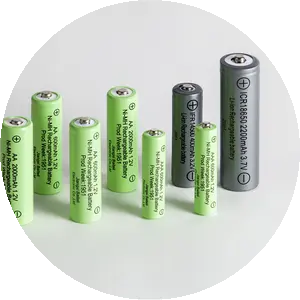
Rechargeable batteries
Rechargeable batteries, or secondary batteries, are used in solar cell products where they are charged by the sun. In ordinary household lighting, they can replace 1.5 V disposable batteries. A rechargeable battery can also be charged in a battery charger designed for the correct voltage.
Tips & Advice
Keep the batteries in their packaging until you are ready to use them. They are perishable.
Do not mix new and old batteries or batteries from different manufacturers in the same product.
The capacity of alkaline batteries is affected by the actual power output – it is lower at high power output than at low power output. The specified capacity refers to use at low current draw.
Always ensure that the + and – poles are positioned correctly to avoid short circuits.
When you need to replace a rechargeable battery and the exact same mAh is not available, you can use the closest equivalent battery in our range.
Rechargeable batteries self-discharge, but can easily be recharged.
Frequently asked questions
Are batteries affected by different temperatures?
Yes, extreme heat or cold reduces battery performance.
How can I make my batteries last longer?
Remove batteries from devices that will not be used for a while. Store them in a dry, ventilated place at room temperature, away from sunlight.
What is meant by service life and cycle?
The service life of a battery describes the number of full charges and discharges that a battery can withstand before its capacity falls below a certain level of its original capacity. This is usually referred to as cycles.
How do I choose the right charger for my rechargeable batteries?
Check the type of battery you intend to buy a charger for; the most common is 1.2 V NiMH. You can find such a charger in regular grocery stores and it does not cost much. There are also universal chargers that can handle all battery types and most sizes, but they are more expensive.
Where do I dispose of a used battery?
Batteries must be recycled at specially designated locations and recycling stations.